
ESPECIALLY I DO BELIEVE: THE LEGACY OF MARGARET BONDS
Margaret Allison Bonds (1913–1972)
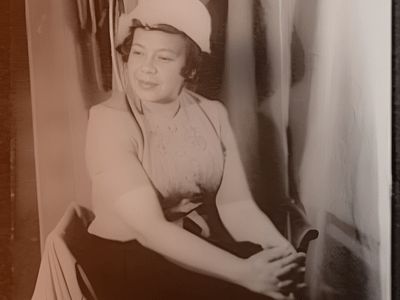
Margaret Allison Bonds was one of the most gifted and visionary American composers of the twentieth century—a musician whose work bridged classical tradition with the spiritual, poetic, and cultural life of Black America…
Born in Chicago on March 3, 1913, Bonds grew up in a home where music and civil rights activism shaped daily life. Her mother, Estella C. Bonds, was a professional musician and her first piano teacher. Her father, Dr. Monroe Majors, was a physician and civil rights advocate. Their home welcomed artists and intellectuals such as Florence Price and Langston Hughes, relationships that would deeply influence her creative path.
A prodigy who began composing at age 13, Bonds earned both her Bachelor and Master of Music degrees from Northwestern University by age 21, overcoming the barriers of segregation that limited access and opportunity. In 1933, she made history as the first Black soloist to perform with the Chicago Symphony Orchestra, appearing at the Century of Progress World’s Fair in a landmark moment for American music.
Across her lifetime, Bonds composed more than 200 works, including art songs, cantatas, piano pieces, choral works, and theatrical compositions. Her collaborations with Langston Hughes—among them The Negro Speaks of Rivers, Three Dream Portraits, and The Ballad of the Brown King—remain central to her legacy. Her music fuses classical forms with spirituals, jazz harmonies, blues idioms, and a deep commitment to social justice. In works such as Montgomery Variations, dedicated to Dr. Martin Luther King Jr., she demonstrated her belief that music could respond to and shape the moral questions of her time.
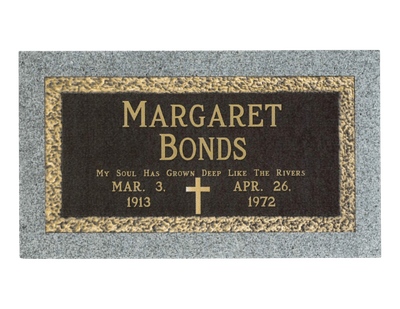
For decades after her passing, however, her Chicago grave remained unmarked—a stark contrast to the scope of her contributions. Through the efforts of Chicago Sinfonietta CEO Sidney Jackson, in partnership with Bonds’ family and Northwestern University, a headstone has now been dedicated in her honor. The tribute marks not only a physical memorial, but a renewed public recognition of her enduring impact.
More than fifty years later, Margaret Bonds’ music continues to uplift, console, and transform—just as she believed it could.
LYRICS & Bios
1. Lift ev’ry voice and sing
till earth and heaven ring,
Ring with the harmonies of liberty.
Let our rejoicing rise
high as the list’ning skies;
Let it resound loud as the rolling sea.
Sing a song full of the faith that the dark past has taught us;
Sing a song full of the hope that the present has brought us;
Facing the rising sun
of our new day begun,
Let us march on till victory is won.
2. Stony the road we trod,
bitter the chast’ning rod,
Felt in the days when hope unborn had died.
Yet with a steady beat,
have not our weary feet
Come to the place for which our fathers sighed?
We have come over a way that with tears has been watered.
We have come, treading our path thru’ the blood of the slaughtered,
Out from the gloomy past,
till now we stand at last
Where the white gleam of our bright star is cast.
3. God of our weary years,
God of our silent tears,
Thou who hast brought us thus far on the way,
Thou who hast by thy might
led us into the light,
Keep us forever in the path, we pray.
Lest our feet stray from the places, our God, where we met thee,
Lest our hearts, drunk with the wine of the world, we forget thee.
Shadowed beneath thy hand,
may we forever stand,
True to our God, true to our native land.
Rosalyn W. Floyd is a Professor of piano, accompanying, and music theory in the Department of Music at Augusta University. A graduate of Talladega College in Alabama, Dr. Floyd holds the Doctor of Musical Arts degree in Piano Performance and Pedagogy from the University of South Carolina.
Best known as a collaborative artist, Dr. Floyd has accompanied the world-renowned soprano Martino Arroyo, noted baritones Oral Moses and Timothy Jones, sopranos Linda Banister, Laquita Mitchell, and Levone Tobin Scott, and the Augusta Choral Society. Dr. Floyd’s collaborative endeavors have taken her to many areas throughout the United States, the Bahamas, and the Peoples’ Republic of China. Named as the Greater Augusta Arts Council Artist of the Year (2005), Dr. Floyd can be heard as the accompanist on the Albany Records recording Oral Moses Sings Songs of America (TROY 1101).
Praised for her “soulful” and “eloquent” playing (Musical America), Decca US Recording Artist harpist Ashley Jackson enjoys a multifaceted career as a highly sought-after musician and collaborator. Replenishing and immersive, her most recent album Take Me to the Water embraces the transportive heft of the harp, conjuring a radiant vision of a world anchored by hope and brighter days. Her highly-acclaimed debut album Ennaga garnered worldwide acclaim for its consideration of American music and its roots in Black spirituality. Nate Chinen (WRTI) praised: “Ennanga is a gemlike offering precisely because she balances her instrument and its expressive potential against that moral calling, framing each gesture in personal terms.”
As a soloist, she has performed at Lincoln Center, Celebrate Brooklyn! and the Schomburg Center for Research in Black Culture. She has also performed with the New York Philharmonic, the Qatar Philharmonic, and is a member of the Harlem Chamber Players.
Throughout her academic and professional careers, Ashley has demonstrated a commitment to diversity and inclusion within higher education and the performing arts, firmly believing that a deeper understanding of cultural and ethnic diversity is critical to intellectual and artistic development. Her groundbreaking research on composer Margaret Bonds culminated in the release of the album, The Ballad of the Brown King and Selected Songs (Avie Records) on which she is a featured performer, as well as the author of the liner notes. Some of her other writings include “Envisioning an Anti-Racist Vision for the Arts: The Arabella Freeman Series” in Hilary Harkness: Everything for You, and “Envisioning an Anti-Racist Vision for Classical Music” for Channel THIRTEEN | New York Public Media.
Her speaking engagements have included “How Have Innovative Women Challenged Orchestral Norms,” a panel discussion for The Unanswered Question series (NY Philharmonic), “1960: Margaret Bonds and a Message for Civil Rights” (Juilliard), “Affinities: Margaret Bonds and Langston Hughes,” (Studio Museum of Harlem) and “Representation as Resistance: How an Activist Orchestra Redresses the Push-out of Black Practitioners from Classical Music” (Harvard University).
She is currently an Assistant Professor and the Director of Performance for the Music Department at Hunter College, where she teaches chamber music, harp, and courses such as Arts in New York City and Storytelling through Performance.
Ashley holds a Doctor of Musical Arts degree from the Juilliard School, a Master of Music degree from the Yale School of Music, and a Bachelor of Arts degree from Yale University.
Hailed by the New York Times as a “virtuoso pianist,” Artina McCain, has built a formidable career as a multi-faceted creative. As a recitalist, her credits include performances at Wigmore Hall and Barbican Centre in London, Walt Disney Concert Hall, Weill Hall at Carnegie in New York City, and more. Other highlights include guest appearances with the Dallas Symphony Orchestra, Memphis Symphony Orchestra, and others.
Dedicated to presenting works of unsung voices, she is a recording artist and publishing advocate. Recordings including collaborative projects: I, Too (Naxos) focused on African American Spirituals and Art Songs and multiple recordings with husband and duo partner, Martin McCain. She arranged Twenty-Four Traditional African American Folk Songs published by Hal Leonard for intermediate pianists. In 2026, Frances Clark Center will publish her edition of virtuosic piano works by grammy award winning composer, Joseph Joubert.
A multi-faceted artist, McCain has been featured in a mirage of spaces. Most recently, she performed as part of El Dorado Ballroom, a multidisciplinary production curated by Solange Knowles. From mistress of ceremony at the Van Cliburn International Piano Competition to guest artist at the annual Gates Foundation Goalkeepers event at Jazz at Lincoln Center. Television appearances include the award-winning PBS documentary series Roadtrip Nation: Degree of Impact in an episode exploring the real-world impact of professionals with doctoral degrees in and outside of academia. Other television appearances include features on CSPAN for the MLK 50 Commemoration.
After not performing for 6 years while battling a performance injury, she enjoys a prolific concert career with more than 10 years of full injury recovery. She uses her recovery to serve as an advocate of musicians’ wellness–curating articles, lectures, and forums to educate teachers and students. Most recently, the BBC featured her on the podcast Sideways, telling her miraculous story of injury to recovery. McCain has written and presented on wellness and other topics in publications and at multiple universities and national conferences.
McCain graduated from Southern Methodist University (BM), Cleveland Institute of Music (MM) and the University of Texas at Austin (DMA). An avid presenter of chamber music, she is Artistic Curator at PRIZM ensemble. As an educator, she is Associate Professor of Piano and Coordinator of the Keyboard Area at the University of Memphis and Co-Founder/Director of the Memphis International Piano Festival and Competition.
In her spare time, Artina enjoys boutique shopping, traveling internationally, and is an enthusiastic foodie and tea aficionado.
Artina McCain is a Yamaha Artist. More info artinamccain.com
GRAMMY-nominated conductor Malcolm J. Merriweather is Director of the New York Philharmonic Chorus and Music Director of New York City’s The Dessoff Choirs and Orchestra. He holds the Tania León Endowed Chair in Music at Brooklyn College.
Highlights of his 2025–2026 season include preparing the New York Philharmonic Chorus for world premieres by David Lang (The Wealth of Nations) and Ellen Reid (Earth Between Oceans), singing the baritone role in Mark Campbell and Peter Boyer’s A Hundred Years On with The Philadelphia Orchestra and The Crossing, and performing the title role in Frederick with Music Worcester. Celebrating his tenth anniversary with the Dessoff Choirs, he conducts Adolphus Hailstork’s The World Called, Bach’s Mass in B Minor with period orchestra, Herbert Howells’s Requiem, a reprise of Tania León’s It’s a journey, and prepares the chorus for two appearances with Andrea Bocelli at Madison Square Garden.
Merriweather is acclaimed for world premiere recordings of Margaret Bonds’s The Ballad of the Brown King, Credo, and Simon Bore the Cross (AVIE Records). At the invitation of Solange Knowles, he joined Saint Heron for Glory to Glory: A Revival of Devotional Art with Voices of Harlem and The Clark Sisters. His ensembles have appeared at Carnegie Hall, Lincoln Center, Disney Concert Hall, Westminster Abbey, and before Pope Francis at the Vatican.
Toni-Marie Montgomery is the second recipient of the Doctor of Musical Arts degree in piano chamber music and accompanying from the University of Michigan. She also received the Master of Music degree from the University of Michigan. Montgomery graduated magna cum laude from the Philadelphia College of Performing Arts.
Montgomery was a founding member of the Black Music Repertory Ensemble of Columbia College of Chicago. This fifteen-member ensemble specialized in performing works by Black composers and promoted appreciation for the Black musical heritage. Montgomery continues to give recitals and has performed throughout the United States and in Austria, Brazil, Hawaii, Poland, Lithuania, and Latvia. Recent chamber music concerts include performances in Evanston, Ann Arbor and Los Angeles with cellist Anthony Elliott.
In 2003 Montgomery was named dean of the Bienen School of Music. As Northwestern’s first African American dean and the first female dean of its music school, Montgomery launched a host of initiatives that increased the Bienen School’s visibility and enhanced its status as one of the nation’s top music schools. She stepped down as dean in 2023 after a distinguished two-decade tenure.
Montgomery previously served as professor and dean of the School of Fine Arts at the University of Kansas; director of the School of Music at Arizona State University; associate dean of the College of Fine Arts at Arizona State University; assistant dean of the School of Fine Arts at the University of Connecticut; and assistant director of the School of Music and artistic director of the Music Performance Institute at Western Michigan University.
Toni-Marie Montgomery currently serves as secretary of the Gateways Music Festival Board of Directors. She is a member of the boards of trustees of the Chicago Symphony Orchestra Association and the Ravinia Festival.
Grammy-nominated rising star Whitney Morrison has earned praise for her “big, gleaming soprano” (Chicago Classical Review) and “vocally sumptuous” performances (Chicago Tribune). A Chicago native and recent alum of the Ryan Opera Center, Morrison champions the African American aesthetic in classical music, embracing a style of performance that blends classical singing technique with elements of the gospel singing tradition. Of her most recent performance in the Lyric Opera of Chicago’s virtual concert, “Lawrence Brownlee and Friends: The Next Chapter,” Opera News raved, “Whitney Morrison was simply astonishing in everything she sang…This is a voice we need to hear live.”
Morrison is the first ever artist-in-residence at Lyric Opera of Chicago. Her first project in this role, Growing Room, involved a series of pop-up installations in Chicago public spaces in that allowed viewers a rare look into Morrison’s practice and rehearsal.
In 2025, Morrison debuted the role of the Artist/Activist in the world premiere of The Seasons, a co-production featuring works by Vivaldi with Boston Lyric Opera and American Modern Opera Company (AMOC*) developed by Anthony Roth Costanzo with music direction by Stephen Stubbs. Whitney will reprise this role with Opera Philadelphia later this year. She made her AMOC* debut in 2024 as Ottavia in the world premiere performance of Yuval Sharon’s Comet Poppea, a role which she will reprise at Lincoln Center in the summer.
Morrison received a 2023 Grammy nomination for Boston Modern Orchestra Project’s recording of The life and Times of Malcolm X, in which she sang the role of Louise/Betty. In 2022, she made her debut with Michigan Opera Theatre in the same role and reprised it with Opera Omaha and Odyssey Opera, before going on to record it with BMOP.
Her 2022-2023 season also included performances with Lyric Opera of Chicago as Yasmine Miller in the world premiere production of Proximity, and with Chicago Opera Theater as Lady Billows in Albert Herring. In the 2023-2024 season, Morrison starred as Mimi in La bohème with Berkshire Opera Festival and returned to Lyric Opera of Chicago to star as Emelda Griffith in Terrence Blanchard’s Champion.
The previous season, she covered the role of Billie in Fire Shut up in My Bones with the Lyric Opera of Chicago and the Metropolitan Opera, where she covered the role again in 2024, along with the role of Louise/Betty in The life and Times of Malcolm X in 2023.
She recently appeared as Leonie Baker in the world premiere of Freedom Ride at Chicago Opera Theater, prompting The Wall Street Journal to declare, “One impassioned aria caught my ear: Leonie Baker (soprano Whitney Morrison)” and Classical Voice America to say, “the production’s big surprise was soprano Whitney Morrison, who nearly stole the show.” Morrison also garnered acclaim for her “richly textured performance and luxurious voice” (The Times Weekly) as Sister Rose in Dead Man Walking at the Lyric Opera of Chicago. While at the Ryan Opera Center, Morrison covered the roles of Liù (Turandot), Marguerite (Faust) and Mimì (La Bohème) and performed as Countess Ceprano (Rigoletto), Gerhilde (Die Walküre) the First Cretan Woman (Idomeneo) and the Confidante (Elektra). Other recent credits include the role of Donna Anna (Don Giovanni) with Chicago’s Floating Opera Company and appearances at the 2018 Grant Park Music Festival and the Rochester Institute of Technology’s celebration of Martin Luther King Jr.’s legacy, “MLK Expressions.”
Morrison’s musical blessings arrived at an early age. Her parents would put her on the table and she would happily perform a favorite church song for anyone within earshot. In her youth, she reveled in the diverse music and charismatic culture of the black church where her grandfather pastored, and eagerly anticipated the annual performance of Handel’s Messiah at Progressive Baptist, the church attended by her aunts and grandparents. To this day, Morrison credits her love of classical music and her continued commitment to music ministry to her upbringing in the church.
As a teenager, Morrison attended Rich South High School in Richton Park, IL, where she studied classical voice, pedagogy and music theory under the school’s then Director of Choral Music, Lana Manson. Recognizing her talents, Manson offered free voice lessons after school, and upon graduation recommended Morrison continue her studies at Alabama’s Oakwood University to pursue her bachelor’s degree in Vocal Performance and Pedagogy. There, under the tutelage of Dr. Julie Moore Foster, she performed her first operatic roles as Miss Pinkerton in Menotti’s The Old Maid and the Thief and as the Countess in scenes from Mozart’s Le Nozze di Figaro. She was also a soloist and member of the elite traveling ensemble the Aeolians, with whom she toured much of the United States and abroad to Moscow, Russia. Her continued studies led her to a master’s degree in music from the Eastman School of Music.
A 2020 National Semifinalist in the Metropolitan Opera National Council Auditions, Morrison also counts among her many accolades first place in the National Classical Singer University Competition, top honors in the Musicians Club of Women Competition, selection as a finalist in the Luminarts Classical Music Competition and recipient of a She Shines Award from Girls Inc. of Chicago. Morrison is a two-time recipient of the UNCF John
Lennon Endowed Scholarship and also trained at the Georg Solti Accademia di Bel Canto in Italy and the Neil Semer Vocal Institute in Germany.
Morrison hosts a podcast called The Artist Sanctuary and is developing an artist advocacy project.
Louise Toppin has received critical acclaim for her operatic, orchestral, and oratorio performances in the United States, Europe, Czech Republic, Sweden, Uruguay, Scotland, China, England, New Zealand, the Caribbean, Cuba, Puerto Rico, Colombia, Bermuda, Japan, and Spain.
Toppin has appeared in recital on many concert series including Carnegie Hall, Merkin Hall, Kennedy Center, and Lincoln Center. Orchestral appearances include: the Norrköping Symphony (Sweden), the Czech National Symphony, Mälmo Symphony Orchestra, (Sweden), Tokyo City Orchestra (Japan), The Montevideo Philharmonic (Uruguay), the Scotland Festival Orchestra (Aberdeen, Scotland), the Honolulu, Toledo, Canton, North Carolina, Charlotte, Lafayette, Erie Chamber and Raleigh Chamber Symphony Orchestras, The Bach Aria Group, Phoenix Bach Consort, and the Washington D.C. Bach Consort with conductors such as: Murry Sidlin, Paul Freeman, Richard Aulden Clark, Justin Brown, James Meena, Vladmir Ashkenazy, and Gearhart Zimmerman.
Toppin’s opera roles include: the title role in the world premiere of the opera Luyala by William Banfield, Treemonisha in Scott Joplin’s Treemonisha, Mary in William Grant Still’s Highway One, Maria in the world premiere of Joel Feigin’s opera Twelfth Night, the Queen of the Night in Mozart’s Magic Flute, Donna Anna in Mozart’s Don Giovanni, and Clara in Gershwin’s Porgy and Bess. She most recently was contracted to sing Clara in Gershwin’s Porgy and Bess for Baltimore Opera, Opera Carolina, and Piedmont Opera companies.
For Joanne Rile Artist Management, she tours in “Gershwin on Broadway” with pianist Leon Bates and Robert Sims. She has recorded seventeen compact disks of American music including Songs of Illumination (Centaur Records), More Still (Cambria), Ah love, but a day (Albany), Paul Freeman Introduces… Vol. I and II and Witness (Albany) with the Czech National Symphony, William Grant Still’s opera Highway One (Visionary Records), He’ll Bring it to Pass (Albany Records), Heart on the Wall with the Dvorak Symphony Orchestra (Albany Records), the recording for A Hall Johnson Collection published by Carl Fisher, and La Saison des Fleurs (music for soprano and fortepiano).
Recent performances include the 150th celebration of the ratification of the 13th amendment for Congress and President Obama at the U.S. Capitol; a performance in Havana, Cuba at the new U.S. Ambassador’s residence; and with the women’s orchestra and in featured recitals for Chautauqua Institute and the opening of the Smithsonian’s African American Heritage Museum.
Since 2010, she has been on the summer faculties of the Baltimore Summer Opera Workshop (Baltimore, MD), the Vocal Course for The National Conservatory (Bogota, Colombia), the Amalfi Coast Music Festival (Maiori, Italy), and the Accra Symphony Operatic Course (Accra, Ghana). She is a much sought-after clinician for colleges and universities throughout the United States.
As a scholar, she has lectured on the music of African American composers and has appeared on NPR’s All Things Considered (Margaret Bonds); for many national conventions including the Society for American Music, the Association for the Study of African American Life and History, the American Cultural Association, the National Association of Negro Music, NASPAM; and on many college campuses including Harvard, Tufts, and Duke.
She served on several boards including the appointments by four North Carolina Governors to the North Carolina Arts Council, NCAC Executive Board, and the African American Heritage Commission. She is the director of the non-profit organization Videmus, and the administrator for the George Shirley Vocal Competition on African American Art Music in Michigan.
Toppin studied with George Shirley, Phyllis Bryn Julson, Reri Grist, and was a fellow at the Britten Aldeburgh Festival studying with Joan Sutherland, Richard Bonynge, and Elly Ameling.
Toppin was the recipient of many teaching awards, including the North Carolina Board of Governor’s Excellence in Teaching Award (the state’s highest award). She is also a recipient of the National Opera Association Legacy Award and the African American Art Song Achievement Award. Her students have won Tucker Foundation Awards and are singing at major opera companies including San Francisco, the Metropolitan Opera, Chicago Lyric, Washington National, Seattle Opera, and companies in Europe, as well as in Broadway touring productions.
Previously, Toppin was the Kappa Kappa Gamma Distinguished University Professor of Music and Chair of the Department of Music at the University of North Carolina, Chapel Hill. She joined the voice faculty of SMTD in the fall of 2017.
Born on 6 January 2007, Sophia Zheng developed a strong passion for music from an early age and began performing in small recitals as a child. In 2013, she won the Shanghai Youth Piano Competition and continued to receive top prizes in the same competition over the following three years. Sophia previously studied piano at the Shanghai Conservatory of Music under the guidance of Natalia Filippova. After moving to the United States in 2019, she continued her musical training in New Jersey with Stella Xu. She has achieved notable success in national and international competitions, including being named a 2024 YoungArts National Competition Finalist, winning Third Prize at the 2024 MTNA National Competition, and receiving Third Prize at the 2024 Kaufman Music Center International Youth Piano Competition. She is currently a dual-degree student at Northwestern University, pursuing a degree in piano performance under the instruction of Dr. Sylvia Wang while completing her studies in economics.